How to Practice Right: 10 Commandments for Drummers and Musicians
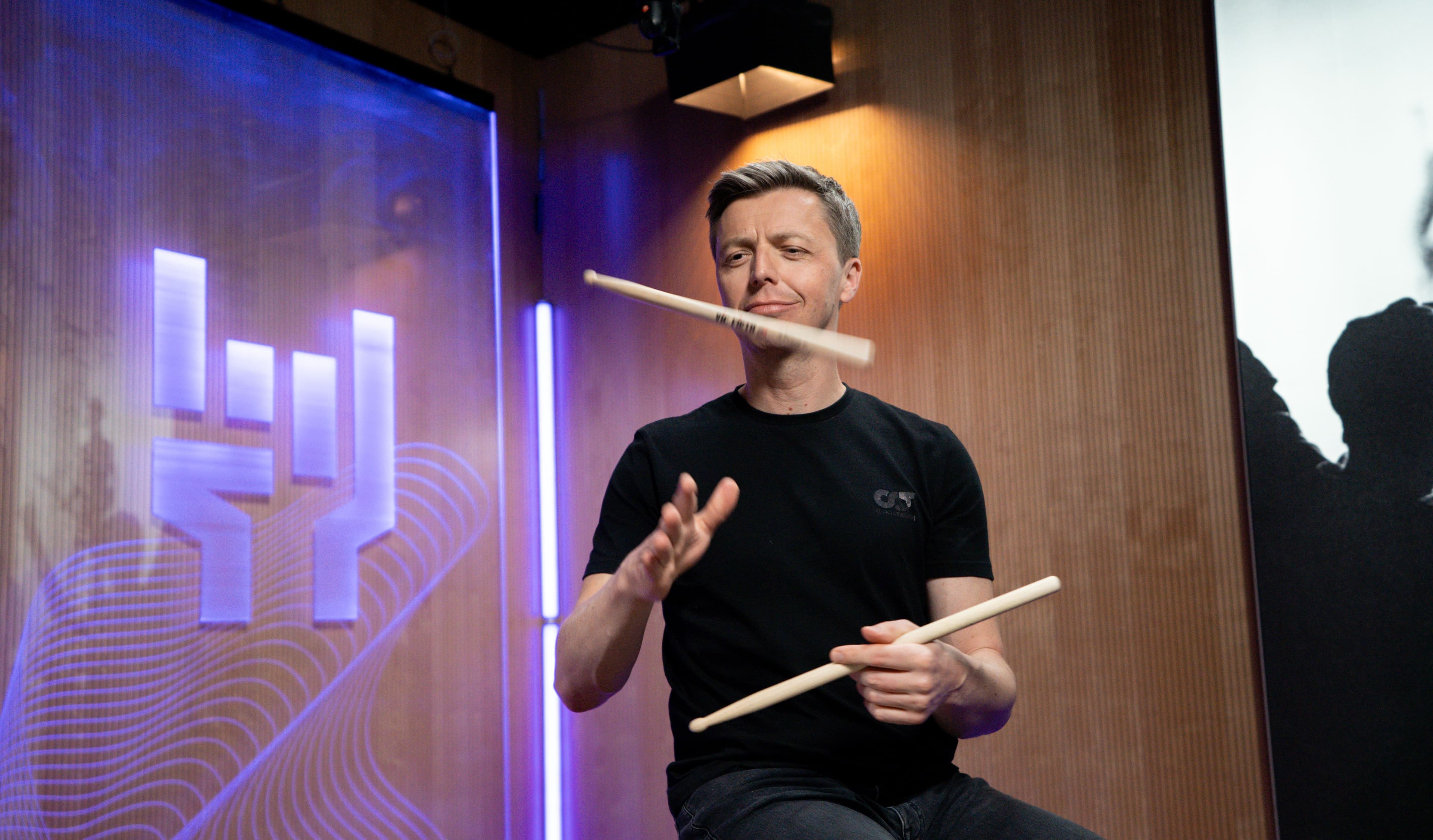
This week, the MyGroove team asked me to write about how to practice properly. Well, that’s not an easy question to answer, because there is no single approach that works for everyone. But there are a few lessons I’ve learned over the past 30 years, both on my own and from working with my students.
And there was one eye-opening moment: a masterclass I took as a 13-year-old drummer with marimba legend Leigh Howard Stevens. In a single afternoon in the summer of 1996, he truly opened my eyes, and he has shaped the way I practice to this day.
It started with the fact that I played everything too fast and very sloppily. The notes were often wrong, I regularly ground to a halt at the difficult passages, or I got thrown right out of the piece or song altogether. I was highly motivated, lightning fast, and totally ready for any competition. But I wasn’t playing well.
So on a hot summer afternoon in Salzburg, Leigh Howard Stevens, after whom the famous Stevens grip on the marimba is named, took me aside and read me the riot act: “Martin, the way you practice, the way you try to get better will lead to nothing. Your approach is awful.” I was young back then, and I’ve always liked straight talk. So I asked him point-blank how to do it better. The 10 commandments I’m about to explain work equally well for hobbyists, serious amateurs, students and pros. They come from Leigh Howard Stevens’ practice bible, and they are my only yardstick on this question. Here are the 10 Commandments of Practicing, according to Leigh Howard Stevens:
Commandment 1:
Always practice with full concentration! No matter what you’re playing, and no matter how hard or seemingly easy the challenge is, your whole focus belongs on the next few bars. Develop tunnel vision: switch off all your devices and direct your attention to your musical challenge. Ten minutes of full concentration beat two hours with YouTube running in the background.
Commandment 2:
Write the most important details of your technique on a large poster and keep it in front of you whenever you practice. For us drummers, that means things like posture, position at the instrument, finger placement on the sticks, and the proportions between elbows, torso, knees, shoulders and wrists, etc. That way, these key details are literally always in your sights.
Commandment 3:
The metronome is your constant companion, because you want to practice efficiently, too. What that means is that you pack several important parameters into one exercise. Technique, repertoire, timing, phrasing and memorizing the notes can always be combined in a single exercise. The metronome will sharpen your timing and precision. It makes sure that an exercise practiced slowly stays slow. And it will remind you that your muscles need every single exercise at a really slow tempo so that the movement becomes automatic.
Commandment 4:
Perhaps the most important rule: if you want to master anything in life at an exceptional level, you have to practice it slowly tens of thousands of times. The slower, the better. The more focused, the more successful. The more meticulous, the more efficient. It was my meditation during long nights between 2 and 4 a.m., when my body was drained and had no strength left. But slow practice of the very hardest passages was still doable. And those were the extra hours that supercharged my playing and my stamina. So how do you practice slowly? You take on 2–4 bars. Let’s say the original tempo is 140. Set the metronome to 25 and try to play those bars perfectly: perfect note sequences, perfect position at the instrument, perfect rhythm. Once you’ve played it at 25 at least 10 times in a row without a single mistake, move the metronome up to 27. If you make one mistake within those 10 repetitions, the count starts over at 1. So you need 10 flawless runs in a row before you’re allowed to raise the metronome by 2 BPM. This method feels tedious and absurd. But here’s my promise: it etches pieces and difficult passages into your memory with perfect accuracy, and for a lifetime. I could still play some pieces from that time perfectly at 4 a.m., half asleep, 30 years later, because my muscles know exactly where the journey is headed. All things considered, it’s the fastest and most efficient way to practice.
Commandment 5:
Whether you’re an amateur or a professional musician, always practice a phrase in its full context. For example, a four-bar phrase has notes and rhythms, but it often also has dynamic markings (louder, softer) or special interpretive features such as accents, staccatos, marcatos, etc. What matters is that you ALWAYS practice everything together from the start. When a phrase has special musical features, they change the automated movement pattern of your muscles, so it’s better to build them in right away. One last example: a rock shuffle pattern often has ghost notes in a phrase. Those ghost notes should be included right from the start when you practice slowly.
Commandment 6:
Never practice when you play! In an ensemble rehearsal, a band rehearsal, a rehearsal with your local town band, at a concert and so on, you don’t practice!
An important rule of practicing is that you never practice when you’re in a shared musical situation. If you’re meeting for band rehearsal, you’ve already done your homework beforehand and you know exactly what you’re supposed to play. The same goes for ensemble, orchestra and choir rehearsals, and for hobbyists and pros alike. By the time you’re on stage or in rehearsal, the practicing has already been done. That has two big advantages: 1. It’s a lot more fun. 2. You don’t get on your fellow musicians’ nerves with your own noodling. That improves the quality of musical life enormously for everyone involved!
Commandment 7:
Never play when you practice! Don’t simulate a performance when you’re supposed to be practicing!
Often people just noodle away in the practice room: one song, then a second. They play through parts of pieces aimlessly and give themselves the impression that they’re practicing something useful. But that has nothing to do with practicing. It’s, to put it mildly, a waste of time. So when you sit down in the rehearsal or practice room, you should really practice, with a plan and a goal. That means following the basic rules above and focusing fully on learning something new, internalizing it, or reviewing it purposefully. But certainly not just playing for the sake of playing.
Commandment 8:
Progress is fun! The beauty of practicing is that you can actually experience your own progress: moving forward and getting better! Nothing is nicer or more satisfying than the feeling of having taken one more step. It’s healthy doping for all of us, and the fuel for your next practice session.
Alongside my students at the University Mozarteum Salzburg, I currently also teach many beginner drummers as part of a project with the Musikum Salzburg. Seeing their eyes light up when they nail the next step, the next groove, the newest fill, is my greatest motivation. I truly love it. It’s my applause!
Commandment 9:
The other day, our MyGroove team was sitting together when a colleague showed us an Instagram video. As we all know, these are short by nature. And yet our wonderful colleague didn’t have the concentration, calm and attention to watch the video to the end with us. Our attention spans are getting shorter and shorter... That is, of course, bad for sustainable practicing. And yet practicing by the 10 commandments can also be an opportunity to learn to concentrate and focus on one thing for longer again. It’s like a mental detox, and it gives us the chance to escape the rules of social media and the quick hit of attention. It’s meditation that works in your favor!
Commandment 10:
As in life, there are many roads to the goal here, too. There are surely plenty of other great ideas for sustainable practice! But these 10 commandments, at least, got me there. Try them out and get better fast with MyGroove!
It's time to take your drumming to the next level
Sign up and try it free for 7 days — your groove is waiting 🎶
Start for free nowAbout the author

Martin Grubinger
Musician & MyGroove Founder
Technical perfection, pure precision and absolute musical joy is what makes him stand out for those who know Martin Grubinger as the world's best multi-percussionist. His unique stage career, as well as his profession at Mozarteum University Salzburg, training the best future talent go along to prove this. These days, Martin is increasingly focused on digital music education and developed the MyGroove App, to transport excitement and motivation for instrument learning into everyone's daily life.