Four on the Floor and Sparkling Eyes: How to Get Off to a Great Start on the Drums
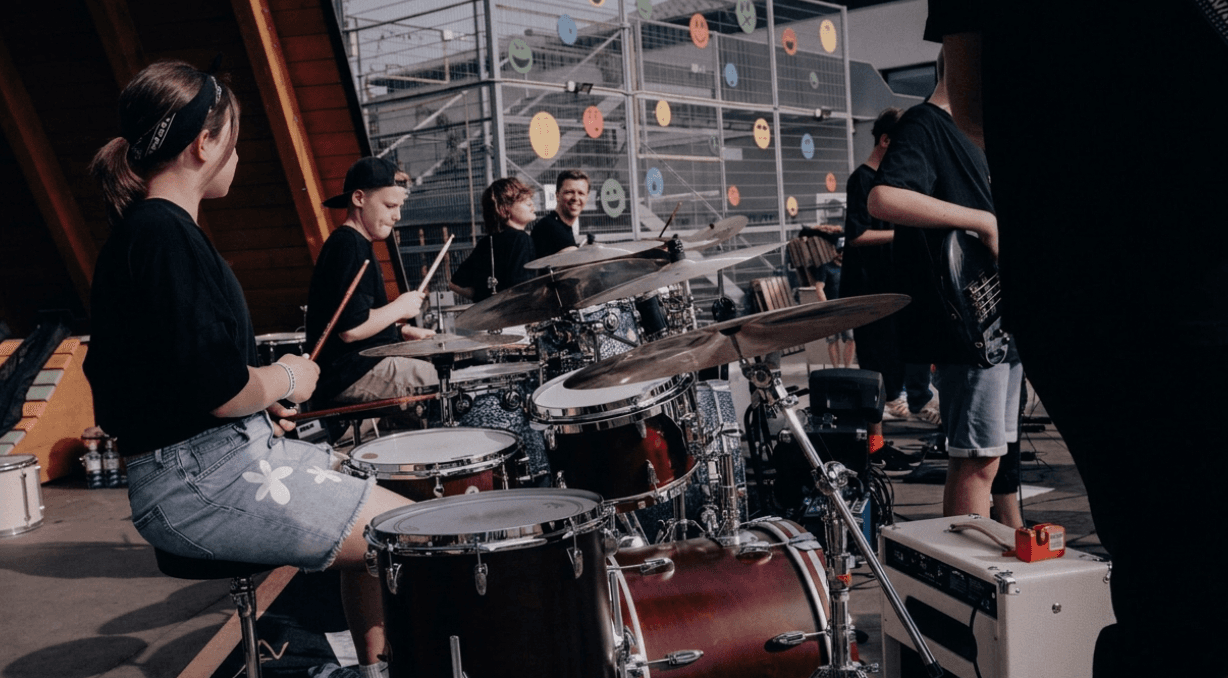
Composure Wins
I'm often asked, mostly by parents, how to make learning an instrument attractive, exciting and fun for children. I have a son myself, and I had the same wish to watch him grow up learning an instrument, so I've been thinking about this over the past few days.
To get it out of the way: with my son Noah, I failed spectacularly at passing on an instrument to him in a joyful way. The reason is easy to explain: I did everything wrong. I was mostly stressed, impatient and unyielding.
All a child needs to make music is a love of play in the best sense, a few sensible musical guardrails for how lessons and practice should work, and warmth from the teacher in the lesson and from the parents during practice at home.
As part of our project for the MyGroove Teacher Tool, I've now made a fresh attempt. I currently teach students aged 6 to 65 and, forgive the self-praise, I think I'm really doing well this time.
First, the drum teacher, in this case me, needs to give the young student his full focus for those 30 minutes. Joy, warmth, laughter, or an encouraging "We'll get this sorted together" can achieve much more than the 500th repetition of an exercise. If both sides look forward to a great drum lesson, the important first step is done.
Subtle signposts
I'm not a fan of simply letting students do whatever they feel like in a lesson, so I set up a few small guardrails between the lines. They are deliberately not rules, but I make sure we stick to the "protocol".
First, as beginners, we playfully tackle a few basics. How do you hold the sticks? How do you sit at the instrument? How do you cope with counting and reading music? This foundation ensures that we can make quick progress with the skills we've learned easily.
After we've played a short excerpt of a song together with very simple rhythms, I bring in my hand techniques after about a third of the lesson. This can and should not feel dogmatic. Mostly these are simple games for the right and left foot combined with the hands, where we sometimes clap on the beat and sometimes off the beat. This trains both halves of the brain and strengthens the synapses and nerve pathways. For children and teenagers, there is truly nothing healthier.
All of this is always accompanied by a funny remark, a little joke, or simply answering questions like "Martin, why are you a Bayern Munich fan?" or "Are you famous?" Lessons with me should be an experience for children and teenagers. They should be fun, the students should look forward to the session with me, and yes, I also want to see us make progress together. We want to get better, and that is another important building block when starting out on a musical instrument. When my students' eyes sparkle at their first "Four on the Floor" beat, I'm in seventh teacher heaven! Because tangible progress is our fuel for the next practice sessions.

So for my students, I design these 30 minutes like a kind of theatre play. There are a few technical exercises, followed by a matching song excerpt. Then a little challenge (Martin vs. student: who is the better drummer), and at the end a few coordination exercises for motor skills and balance. And finally, always the favourite song in full length, for and with my student.
So learning an instrument can be fun from day one. But it takes a few important ingredients that students, parents and teachers should keep in mind.
Four principles for success
No. 1: All three parties must be sure that they really want this. There must never be compulsion, and parents should understand that making music must not be an obligation. However convinced you are that it should be an important part of your children's lives, it still has to come from intrinsic conviction.
No. 2: We want to get better. From day one, it's my goal as a teacher that my students make progress. For me, that is non-negotiable. Learning an instrument can be a wonderful school for life. It includes (anticipatory) joy, perseverance, a bit of discipline and motivating moments of success.
No. 3: Practising is important. We're currently seeing that my students practise happily between lessons. They spend a great deal of time in the MyGroove app, working on the exercises I suggest and send to them. They don't do it because they're afraid or because they're forced to. They do it because they're keen to. That's a good example of our learning method really working.
No. 4: A great teacher isn't always just the nice uncle and class clown. He can also demand things, while always nurturing. But one thing is clear: he must be enthusiastic throughout and live his fascination for his own instrument consistently. If you burn for your instrument, students sense it immediately. I love drums. I love rhythm and timing. I love the beats and patterns that underlie it. And a teacher must be able to convey that joy, because students sense it right away.
Personal evidence
Finally, I want to tell you about the best instrument teacher in the world (I say this deliberately, because I'm certain he is): my father was my drum teacher at the music school in Mondsee. I believe he was born for this job. He trained some of the best drummers, percussion soloists and orchestral musicians in the world. And I simply don't know anyone who doesn't remember legendary lessons with him.
During the years of my solo career, I often practised in the anteroom of his teaching rooms. And in 20 years, I never saw a single unhappy child come out of his classroom. Many students were there at the same time, all drumming away like mad. And in the middle of it, my father, enjoying this "madness" to the fullest. They played football and drummed in the classroom. They staged theatre plays and celebrated the finest drum music. Lessons with my father were a weekly adventure.
Why he enjoyed it so much at the music school, yet by no means found the same joy in teaching students at the university, is something students and the university itself should ask themselves. I'm currently asking myself the same critical questions. I love teaching my young 6-year-old students. There is that naive curiosity and completely unbiased joy, something that students within a university structure mostly no longer have. But I'll write about that another time.
Learning an instrument can be fun for beginners right away and can show great progress quickly. If you know how it works, the fun of playing is basically guaranteed.
With MyGroove the fun in playing is never lost
Get started nowAbout the author
Martin Grubinger
Musician & MyGroove Founder
Technical perfection, pure precision and absolute musical joy is what makes him stand out for those who know Martin Grubinger as the world's best multi-percussionist. His unique stage career, as well as his profession at Mozarteum University Salzburg, training the best future talent go along to prove this. These days, Martin is increasingly focused on digital music education and developed the MyGroove App, to transport excitement and motivation for instrument learning into everyone's daily life.